Electrical insulation is not simply about preventing current from passing between two components.
In modern electrical and electronic equipment, an insulation material may also need to withstand heat, voltage, mechanical stress, chemicals, moisture, vibration and repeated processing while maintaining dimensional stability.
That is why selecting the right electrical insulation film requires more than choosing a film based on thickness or price.
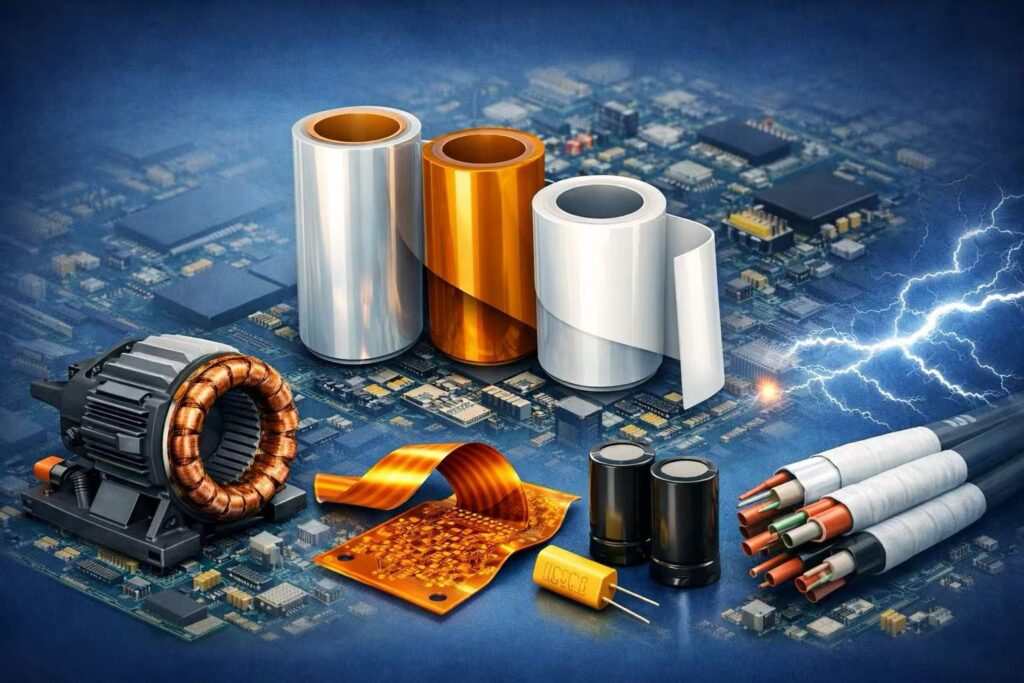
Depending on the application, manufacturers may use polyester (PET), polyimide (PI), polycarbonate, flame-retardant films and other engineered film constructions.
The right choice depends on the combination of:
Electrical performance + temperature + mechanical requirements + environment + fabrication process + application design.
This guide explains the major types of electrical insulation films, where they are used, how to compare them and what engineers and procurement teams should consider before selecting a material.
What Is an Electrical Insulation Film?
An electrical insulation film is a thin polymer or engineered film used to electrically isolate components, conductors, circuits or surfaces from one another.
Unlike rigid insulation materials, films provide electrical separation while remaining thin, flexible, lightweight and easy to convert.
Depending on the material and grade, electrical insulation films can provide:
- Dielectric insulation
- Electrical isolation
- Thermal resistance
- Mechanical protection
- Flame resistance
- Chemical resistance
- Dimensional stability
- Flexibility
- Surface protection
Thin polymer films are widely used in electrical equipment, electronics, motors, transformers, cables, batteries and other industrial systems.
Why Is the Right Insulation Film Important?
An insulation film can be a small component within a larger assembly, but its performance can directly affect system reliability.
For example, the film may need to prevent:
Electrical contact ? short circuits ? component damage ? equipment failure
At the same time, it may need to maintain its properties under elevated temperature or mechanical stress.
A material that performs well at room temperature may not be suitable for an application exposed to continuous heat.
Similarly, a film with excellent dielectric properties may not be the best choice if the application requires repeated folding, complex forming or high chemical resistance.
Therefore, insulation selection should start with the application requirements, not simply the material name.
Main Types of Electrical Insulation Films
There is no single insulation film suitable for every application.
The most appropriate material depends on the electrical, thermal, mechanical and environmental requirements.
1. Polyester (PET) Insulation Film
Polyester film, commonly referred to as PET film, is widely used where manufacturers need a practical combination of:
- Electrical insulation
- Mechanical strength
- Dimensional stability
- Processability
- Cost efficiency
PET films are used in applications such as electrical insulation, wire and cable insulation and industrial components. Manufacturers also offer PET grades designed for specific insulation and fabrication requirements.
Typical applications
- Motor insulation
- Transformer components
- Coil insulation
- Cable insulation
- Electronic components
- Die-cut insulation parts
- Laminated insulation structures
PET is often a sensible starting point when the application does not require the extreme temperature performance associated with polyimide.
2. Polyimide (PI) Film
Polyimide film is selected when electrical insulation must operate under demanding thermal conditions.
Polyimide films are known for:
- High temperature resistance
- Electrical insulation
- Dimensional stability
- Chemical resistance
- Mechanical durability
- Flexibility
They are used in applications including flexible electronics, motors, aerospace systems, high-temperature insulation and electronic components.
Typical applications
- High-temperature electrical insulation
- Flexible circuits
- Motor insulation
- Transformer components
- Wire and cable insulation
- Battery systems
- Aerospace electronics
- Semiconductor-related applications
For high-temperature applications, polyimide can offer performance that conventional polyester films cannot match.
3. Polycarbonate Films
Polycarbonate films can be useful when an application requires a combination of:
- Electrical insulation
- Mechanical strength
- Formability
- Flame-retardant performance
- Surface durability
Knowell’s electrical film portfolio includes flame-retardant polycarbonate films, including LEXAN™ FR film constructions, which are designed for insulation and printability and are available in different surface textures. Knowell Group
Typical applications
- Electrical components
- Electronics
- Insulating barriers
- Labels and overlays
- Printed circuit applications
- Formed components
Polycarbonate can therefore be particularly relevant when the insulation film also needs to contribute to the physical structure or appearance of the component.
4. Flame-Retardant Electrical Films
Some electrical and electronic applications require more than electrical isolation.
The material may also need to help meet specific flammability or fire-performance requirements.
Flame-retardant films can be considered for applications involving:
- Power electronics
- Electrical housings
- Electronic assemblies
- Battery-related systems
- Insulating barriers
- Industrial equipment
Knowell’s electrical film portfolio specifically includes flame-resistant materials and films designed for electrical and electronics OEM applications. Knowell Group
Important: flame-retardant performance is grade-specific. Always evaluate the actual manufacturer’s technical data and applicable test standard for the intended application.
PET vs Polyimide vs Polycarbonate: Which Should You Choose?
There is no universal “best” electrical insulation film.
The correct material depends on what the component needs to withstand.
| Requirement | PET | Polyimide | Polycarbonate |
|---|---|---|---|
| General electrical insulation | Excellent | Excellent | Good–Excellent |
| High-temperature applications | Moderate | Excellent | Moderate |
| Mechanical strength | Good | Excellent | Excellent |
| Flexibility | Good | Excellent | Good |
| Dimensional stability | Excellent | Excellent | Good–Excellent |
| Formability | Good | Good | Excellent |
| Flame-retardant grades | Available | Available depending on grade | Strong option |
| Electronics | Common | Excellent for demanding applications | Common |
| Cost-sensitive applications | Strong option | Higher-performance option | Application dependent |
These are general material-selection tendencies, not specifications for every grade. Actual performance varies by film formulation, thickness, surface treatment and manufacturer.
What Properties Should You Evaluate?
This is where many generic articles stop too early.
For an engineering or procurement decision, “electrical insulation” is not enough information.
You should evaluate several technical parameters.
1. Dielectric Strength
Dielectric strength indicates the electrical field a material can withstand before electrical breakdown occurs under defined test conditions.
A higher value can be useful where electrical stress is high, but it should never be evaluated in isolation.
Thickness, temperature, humidity, test method and material construction can affect actual performance.
2. Operating Temperature
Temperature is one of the most important selection factors.
Ask:
What temperature will the film experience continuously?
And also:
What is the maximum short-term temperature?
PET is commonly used in lower-temperature insulation systems, while polyimide is selected for significantly more demanding thermal environments. Some insulation systems classify materials according to thermal classes such as Class B, F or H.
3. Film Thickness
Thicker is not automatically better.
Thickness affects:
- Dielectric performance
- Mechanical strength
- Flexibility
- Formability
- Component dimensions
- Cost
- Die-cutting behaviour
The correct thickness should be determined from the electrical and mechanical requirements of the application.
4. Mechanical Strength
An insulation film may be subjected to:
- Pulling
- Folding
- Bending
- Abrasion
- Vibration
- Installation stress
For components that need repeated forming or handling, mechanical properties can be as important as dielectric performance.
5. Dimensional Stability
Dimensional stability becomes particularly important when the film is:
- Die-cut
- Laminated
- Formed
- Printed
- Used as a precision component
- Installed into a small assembly
A film that changes dimensions significantly during processing or temperature cycling can create assembly problems.
6. Chemical & Moisture Resistance
Consider the environment in which the film will operate.
Potential exposure may include:
- Oils
- Solvents
- Cleaning chemicals
- Water
- Humidity
- Coolants
- Adhesives
- Resins
Material compatibility should be verified against the actual chemicals and operating conditions.
Request
Need Help Selecting an Electrical Insulation Film?
Electrical Insulation Film Applications
Electrical films are used across multiple industries because the requirements can be very different from one application to another.
Motors & Generators
Insulation films can be used for:
- Slot insulation
- Phase insulation
- Interlayer insulation
- Coil wrapping
- Electrical barriers
PET-based insulation films are commonly used in electrical machines, while higher-temperature systems may require polyimide or composite constructions
Transformers
Film materials can be incorporated into:
- Interlayer insulation
- Winding insulation
- Electrical barriers
- Laminated insulation systems
The correct choice depends on voltage, temperature class, thickness and construction.
Electronics
Modern electronic assemblies increasingly require thin insulation components.
Applications can include:
- PCB insulation
- Component isolation
- Display modules
- Connector insulation
- Electronic housings
- Flexible circuits
Polyimide is particularly relevant to flexible electronics and high-temperature applications.
Battery & Energy Applications
Insulation films can be used to electrically isolate components within battery and energy systems.
Potential applications include:
- Cell insulation
- Battery pack barriers
- Component isolation
- Busbar insulation
- Protection layers
- Die-cut insulating components
Knowell’s electrical films page specifically identifies battery packs and adapters for computers, laptops and mobile phones among its applications. Knowell Group
For newer battery applications, however, the exact thermal, dielectric and flame requirements must be evaluated against the cell/module design.
Electrical Insulation Films for Die-Cut Components
A major advantage of technical films is that they can often be converted into precise shapes.
Instead of supplying a large roll of insulation film, a manufacturer may require:
- Washers
- Spacers
- Barriers
- Pads
- Rings
- Custom profiles
- Connector insulators
- Component separators
This is where film selection and converting capability become closely connected.
Knowell’s positioning is particularly relevant here because its product portfolio includes electrical films while its broader offering includes slitting, die cutting and lamination.
Adhesive-Backed Electrical Insulation Films
Some applications require the insulation film to stay in a fixed position during assembly.
In these cases, an adhesive-backed construction may be considered.
The selection process then becomes:
Film + adhesive + liner + substrate + environment
rather than simply:
Film = insulation
The adhesive must be evaluated for:
- Temperature
- Substrate compatibility
- Bond strength
- Aging
- Chemical exposure
- Application method
- Removal requirements
For complex assemblies, a technical material supplier can help determine whether a standard adhesive construction or custom laminated construction is more appropriate.
How to Choose the Right Electrical Insulation Film
Use this checklist before requesting a material or quotation.
Step 1: Define the electrical requirement
Determine:
- Voltage
- Frequency where relevant
- Required dielectric performance
- Clearance and insulation requirements
Step 2: Define the thermal environment
Specify:
- Continuous temperature
- Peak temperature
- Thermal cycling
- Required thermal class
Step 3: Identify the substrate
What will the film contact?
For example:
- Metal
- PCB
- Plastic
- Battery component
- Wire
- Coil
- Composite
Step 4: Define the mechanical requirement
Consider:
- Flexibility
- Folding
- Abrasion
- Tensile stress
- Vibration
- Dimensional stability
Step 5: Define environmental exposure
Consider:
- Moisture
- Oil
- Chemicals
- UV
- Dust
- Outdoor exposure
Step 6: Define the converting requirement
Will the material need to be:
- Slit?
- Laminated?
- Die-cut?
- Kiss-cut?
- Printed?
- Formed?
- Adhesive-backed?
Step 7: Define the production volume
Prototype requirements can be very different from high-volume production.
This can influence:
- Material format
- Converting method
- Tooling
- Delivery format
- Cost
Common Mistakes When Selecting Electrical Insulation Film
1. Choosing purely on price
The cheapest film may not be the lowest-cost solution if premature failure causes production or warranty problems.
2. Choosing based only on dielectric strength
Electrical performance is important, but thermal, mechanical and environmental properties also matter.
3. Ignoring thickness
Thickness affects electrical, mechanical and manufacturing performance.
4. Selecting a material without testing the actual substrate
Film performance in isolation does not guarantee performance in the final assembly.
5. Ignoring the converting process
A material may meet the specification but still be difficult to die-cut, laminate or form.
6. Treating all PET or polyimide films as identical
Different grades can have substantially different properties, coatings, surface treatments and intended applications.
Electrical Insulation Film Selection: A Practical Example
Consider an electronics manufacturer that needs a thin insulating component between an electrical component and a metal housing.
The requirement may look like this:
Application: Electrical isolation
Substrate: Metal + electronic component
Space: Limited
Temperature: Elevated
Shape: Custom with holes/cut-outs
Production: High volume
Assembly: Peel-and-place
A suitable solution may involve:
Technical film ? adhesive construction ? die-cut geometry ? linered delivery
The final material should then be validated for:
- Dielectric requirements
- Temperature
- Adhesion
- Dimensional stability
- Mechanical handling
- Production process
This illustrates why the right solution is not simply “buy an insulation film.”
It is a material + construction + converting + application decision.
Why Custom Converting Matters
For many industrial applications, the film itself is only half of the solution.
The manufacturer may need the material supplied as:
Roll ? slit roll ? laminated construction ? die-cut component ? ready-to-apply part
This can reduce manual assembly work and improve repeatability.
Knowell’s wider offering includes in-house slitting, die cutting and lamination, allowing industrial films and tapes to be converted into application-specific formats. Knowell Group
That creates an important advantage for engineers and procurement teams who need more than a standard roll of material.
Why Choose Knowell for Electrical Insulation Films?
Knowell supplies specialty industrial films and materials for electrical and electronic applications, including films designed for heat and dielectric insulation, die-cut insulators and spacers, PCB applications, EMI shielding and battery-related applications. Knowell Group
More importantly, Knowell combines material supply with technical support and converting capabilities.
Material expertise
Access to specialty films from established global material platforms.
Technical support
Support with product selection, technical information and application requirements.
Custom converting
Films can be evaluated for:
- Slitting
- Die cutting
- Lamination
- Custom formats
Documentation
Knowell provides COA and COC on request for applicable products. Knowell Group
Industrial supply
Knowell has been operating since 1984, with pan-India supply capabilities.
Need Help Selecting an Electrical Insulation Film?
Choosing the right film depends on more than thickness and price.
If you are developing an electrical or electronic component, share your:
- Application
- Operating temperature
- Voltage requirement
- Required thickness
- Substrate
- Required dimensions
- Environmental conditions
- Annual/required quantity
- Die-cut or laminated requirement
with Knowell.
Our team can help evaluate the appropriate film material, construction and converting format for your application.
Frequently Asked Questions
What is electrical insulation film?
Electrical insulation film is a thin insulating material used to electrically isolate components, conductors and surfaces while providing properties such as mechanical protection, thermal resistance and dimensional stability.
Which film is best for electrical insulation?
There is no single best film. PET is commonly used for general electrical insulation, while polyimide is preferred for demanding high-temperature applications. Polycarbonate and other specialty films can be appropriate where formability, flame resistance or mechanical performance is important.
Is PET film suitable for electrical insulation?
Yes. PET films are widely used for electrical insulation because they offer a combination of dielectric performance, mechanical strength, dimensional stability and processability.
What is polyimide film used for?
Polyimide film is commonly used where high thermal resistance and electrical insulation are required, including electronics, flexible circuits, motors, aerospace and other demanding applications.
Can electrical insulation films be die-cut?
Yes. Depending on the film and application, insulation films can be converted into custom shapes such as spacers, barriers, pads, washers and other components.
Can insulation film be supplied with adhesive?
Yes, depending on the film and application. Adhesive-backed constructions can be developed where the insulation component needs to be fixed to a substrate during assembly.
What information should I provide when requesting an insulation film?
Provide the application, voltage, temperature, film thickness, substrate, dimensions, environmental conditions, required quantity and any required converting or certification specifications.