In industrial manufacturing, adhesive tape and technical films are rarely just used as standard rolls.
When a component requires a specific shape, precise dimensions, controlled adhesive coverage or easy peel-and-place application, custom die-cut tape and film parts can provide a more efficient solution.
Instead of manually cutting tape or film during assembly, manufacturers can receive ready-to-apply components designed around the actual part, substrate and production process.
Custom die-cut parts can be used for bonding, mounting, insulation, sealing, masking, protection, cushioning and other industrial applications.
For manufacturers, OEMs, engineers and procurement teams, the challenge is not simply finding a tape. It is selecting the right material, adhesive construction, thickness, geometry, liner and converting process for the application.
This guide explains how custom die-cut tape and film parts work, the materials and formats available, common industrial applications, and what to consider before requesting a custom solution.
What Are Custom Die-Cut Tape & Film Parts?
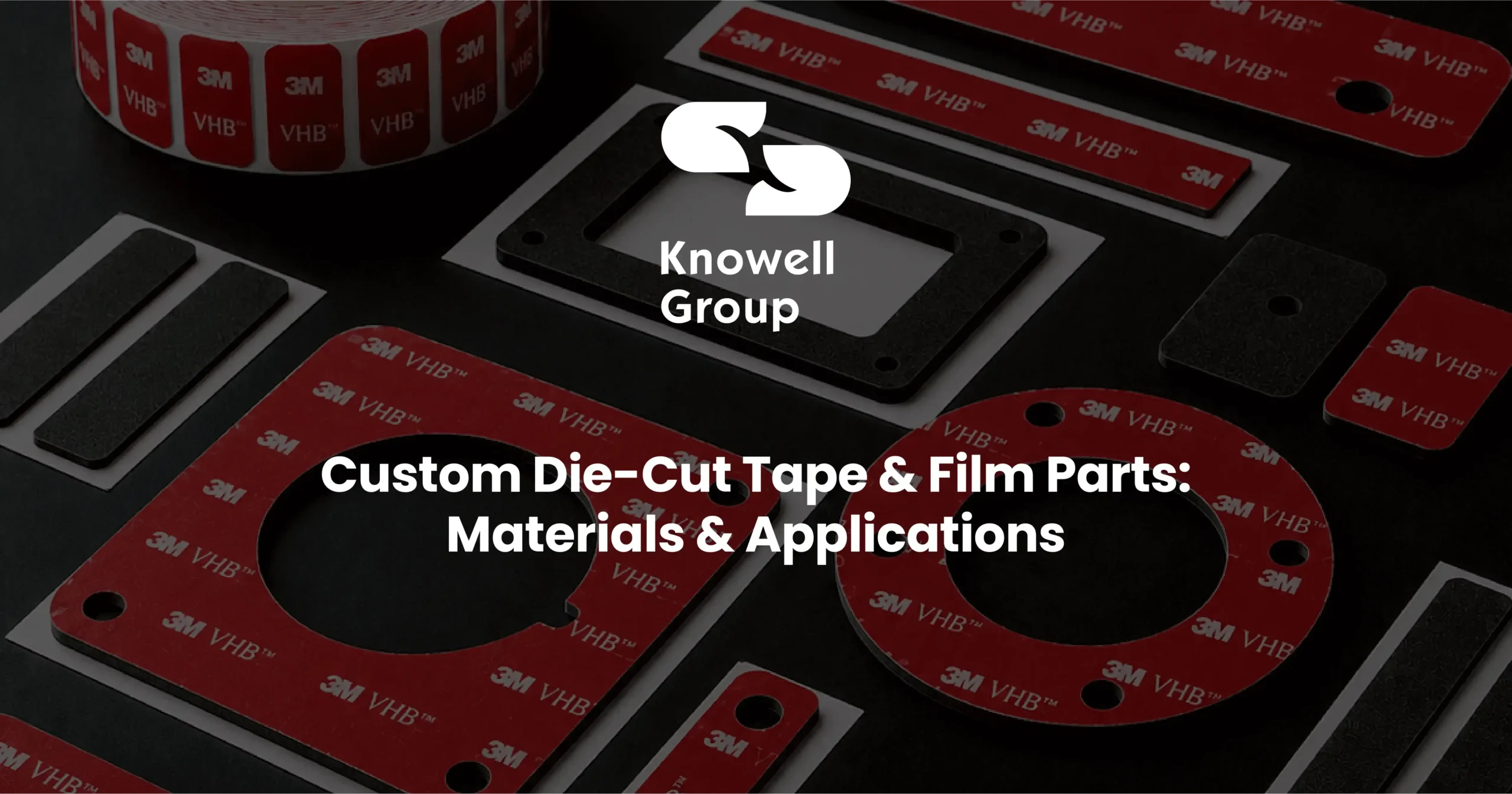
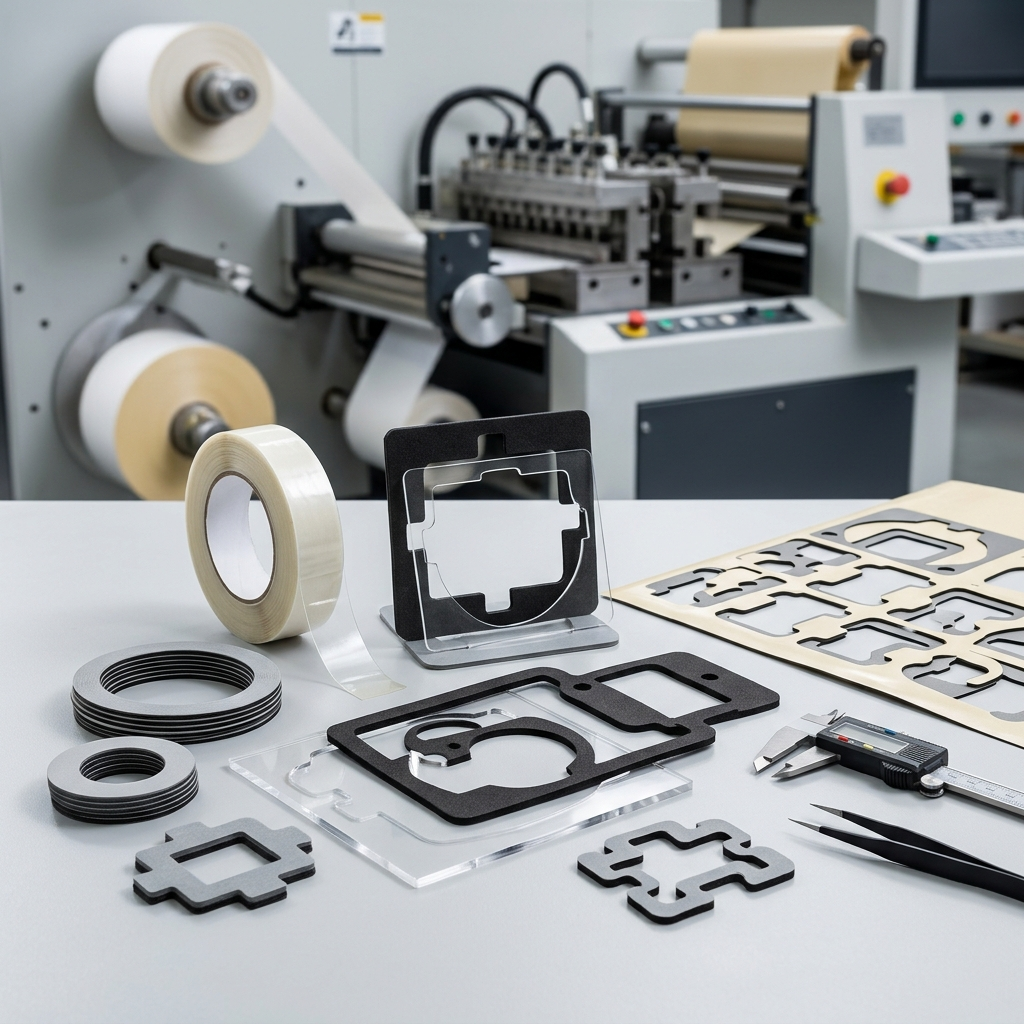
Custom die-cut tape and film parts are precision-shaped components produced by converting adhesive tapes, films, foams or other flexible materials into a specific geometry.
Instead of supplying a standard roll, the material is converted into a required shape such as:
- Pads
- Strips
- Rings
- Washers
- Gaskets
- Frames
- Tabs
- Spacers
- Insulation pieces
- Mounting components
- Protective shapes
- Custom profiles
The finished component can then be supplied on a liner, in sheets, individually or in another format suited to the customer’s assembly process.
For high-volume manufacturing, this can eliminate repetitive manual cutting and help create more consistent parts.
Simple example
Suppose an electronics manufacturer needs a small rectangular adhesive pad inside every assembly.
The conventional process may involve:
Roll of tape ? manual measurement ? cutting ? positioning ? application
A custom die-cut solution changes this to:
Pre-cut adhesive component ? peel ? apply
The converting work happens upstream, allowing the production team to focus on assembly rather than preparing the adhesive material.
Why Do Manufacturers Use Die-Cut Tape & Film Parts?
The biggest advantage isn’t simply the shape.
The real value comes from designing the adhesive or film component around the manufacturing process.
1. Consistent part geometry
Every converted part is produced according to the approved design rather than being manually cut on the production floor.
This can improve repeatability across assemblies.
2. Faster assembly
Pre-cut components can be supplied ready for application, reducing manual cutting and preparation.
3. Reduced material waste
The part geometry can be designed around the application and material, helping manufacturers control unnecessary material usage.
4. Cleaner application
Kiss-cut or linered formats can make individual parts easier to peel and apply without directly handling the adhesive surface.
5. Better integration into production
Die-cut components can be supplied in formats suitable for manual, semi-automatic or automated assembly processes.
6. Multiple functions in one component
A converted part can combine materials or functions such as:
Bonding + insulation
Sealing + cushioning
Mounting + vibration management
Protection + adhesion
This is where custom converting becomes more valuable than simply purchasing a standard tape roll.
What Materials Can Be Die-Cut?
The right material depends on the application rather than simply the required shape.
Common materials used for converted tape and film components include:
| Material / Construction | Typical Applications |
|---|---|
| Double-sided adhesive tape | Bonding, mounting, assembly |
| Acrylic foam tape | High-bond mounting and assembly |
| Transfer adhesive | Thin bonding applications |
| Polyester film | Insulation, labels, protection |
| Polyimide film | High-temperature insulation and masking |
| Foam | Sealing, cushioning, gap filling |
| Rubber | Sealing and cushioning |
| PTFE materials | High-temperature and specialty applications |
| Protective films | Surface protection |
| Thermal materials | Heat-transfer and thermal management |
| Specialty adhesive constructions | Application-specific bonding |
The important point is that material selection should come before tooling.
A part may have the correct dimensions but still fail if the adhesive, film, foam or liner is unsuitable for the operating environment.
How to Select the Right Material for a Die-Cut Part
Before selecting a tape or film, evaluate the actual application.
1. What surfaces need to be bonded or protected?
Identify the substrates.
For example:
- Aluminium
- Stainless steel
- Painted metal
- Glass
- ABS
- Polycarbonate
- PET
- Acrylic
- Rubber
- Foam
- Composite materials
Different surfaces have different adhesion characteristics.
2. What is the purpose of the part?
Is the component primarily being used for:
- Bonding?
- Mounting?
- Sealing?
- Insulation?
- Masking?
- Surface protection?
- Cushioning?
- Thermal management?
- Electrical isolation?
- EMI-related applications?
This determines the material construction you should consider.
3. What environmental conditions will it experience?
Consider:
- Operating temperature
- Humidity
- Water exposure
- Chemicals
- Oils
- UV exposure
- Outdoor conditions
- Vibration
- Mechanical load
- Thermal cycling
A material that works well in a controlled indoor environment may not be appropriate for an automotive, electrical or industrial application.
4. What bond performance is required?
The required adhesive performance depends on:
- Substrate
- Contact area
- Load
- Shear forces
- Peel forces
- Temperature
- Application pressure
- Dwell time
For critical applications, material selection should be based on the actual operating conditions rather than simply choosing the strongest tape available.
Die-Cut vs Kiss-Cut: What’s the Difference?
These terms are often used interchangeably, but they describe different cutting approaches.
Die Cutting
The material is cut into the required shape using a dedicated die.
It is suitable for producing repeatable components in production quantities.
Kiss Cutting
The cutting process cuts through the adhesive/tape material while leaving the release liner intact.
The finished parts remain attached to the liner and can then be peeled individually.
This is particularly useful when the assembly operator needs to:
Peel ? Position ? Apply
without handling individual loose components.
Knowell supports kiss cutting alongside multiple die-cutting approaches and custom assembly aids such as pull tabs and extended liners
Send us your requirement
Need a Custom Die-Cut Tape or Film Part?
Common Die-Cutting Methods
The appropriate process depends on material, geometry, volume and production requirements.
Rotary Die Cutting
Rotary die cutting uses a cylindrical die and is particularly suitable for repeat production and high-volume applications.
It can produce large numbers of consistent parts efficiently.
Flatbed Die Cutting
Flatbed die cutting uses a press and die to produce shaped components.
It can be suitable for prototypes, lower-volume projects and certain complex geometries.
Match-Metal Die Cutting
Match-metal tooling can be considered when tight tolerances or challenging materials require a more controlled cutting approach.
Compound Die Cutting
Compound tooling can perform multiple cutting operations within the same press cycle.
Punch Press
Punch presses can be used for specific shapes and hole-cutting requirements.
Knowell’s current die-cutting capability includes rotary, flatbed, match-metal and compound die cutting, as well as punch press, kiss cutting and perforation processes.
Beyond Die Cutting: Lamination & Multi-Layer Parts
Some applications cannot be solved with a single material.
For example, a component may require:
Film + adhesive + foam + adhesive + liner
This is where lamination becomes important.
Multi-layer constructions can combine different materials to create a component with properties that one material cannot provide alone.
Knowell supports adhesive lamination for single- and double-sided constructions, multilayer materials, dissimilar materials, zoned adhesive patterns and PSA composites. Knowell Group
Example: Zoned Adhesive Components
Some components need adhesive only in selected areas.
This can be useful for applications involving:
- Filters
- Vents
- Mesh
- Protective components
- Controlled bonding areas
Knowell’s existing capability includes zoned adhesive lamination, where adhesive coverage is selectively applied to the required pattern.
Why Work With a Technical Converting Partner?
Buying a standard tape and converting it internally isn’t always the most efficient option.
A technical converting partner can help connect:
Material selection + adhesive performance + geometry + converting process + assembly requirements
Instead of asking only:
“Which tape do you sell?”
the better question is:
“What material and converted format will work best for my application?”
This is particularly important when the component is part of a larger manufactured product.
Knowell combines specialty industrial materials with in-house converting capabilities including slitting, die cutting, lamination, sheeting, plotter cutting and prototyping. Knowell Group
The company also supplies specialty tapes and films from leading brands and provides technical support, with COA/COC documentation available on request.
Why Choose Knowell Group for Custom Die-Cut Tape & Film Parts?
Knowell is positioned not simply as an industrial tape distributor, but as a specialty industrial materials and technical solutions partner.
Material selection
Access to a broad portfolio of industrial tapes, films, foams and specialty materials.
In-house converting
Custom:
- Die cutting
- Kiss cutting
- Slitting
- Lamination
- Sheeting
- Plotter cutting
- Prototyping
Application-focused support
The solution can be evaluated based on the actual application rather than simply the product name.
Prototype-to-production support
Develop and test a component before scaling to production.
Multiple supply formats
Depending on the application, components can be designed around the required assembly method.
Industrial supply capability
Knowell has been serving the industry since 1984 and provides pan-India supply, technical support and documentation support.
Frequently Asked Questions
What is a custom die-cut tape part?
A custom die-cut tape part is a pre-cut adhesive component manufactured to a specific shape and size for an application. It can be used for bonding, mounting, insulation, sealing, masking and other industrial requirements.
Can double-sided tape be die-cut?
Yes. Double-sided adhesive tapes can be converted into custom shapes for mounting, bonding and assembly applications.
Can industrial films be die-cut?
Yes. Depending on the film construction and application, industrial films can be converted into custom shapes and components.
What is kiss-cut tape?
Kiss cutting cuts the tape or adhesive material while leaving the release liner intact. The individual parts remain on the liner for easy peel-and-apply assembly.
Can I get a prototype before production?
Yes. Prototyping can be used to evaluate a design and material before production tooling and larger-volume manufacturing. Knowell provides prototyping capabilities for custom parts. Knowell Group
What information is required for a custom die-cut quote?
A dimensioned drawing or CAD file, material preference, application, substrate, environmental conditions, thickness, quantity and preferred delivery format are useful starting information.
What industries use custom die-cut adhesive parts?
Custom die-cut components are used across automotive, electronics, electrical, industrial manufacturing, aerospace, appliances, signage and other applications where precise adhesive or film components are required.